Lately news media outlets have been printing out information on different media, books, movies and documentaries on viruses. Amidst this pandemic - a situation where there is a global alert halting the entire world, forcing everyone to stay inside - my mind went back through the numerous series I've consumed until I realized that we're not just talking about viruses here, but global control over human beings even in countries that appreciate freedom over anything else.
This line of thinking brought me back to this one Japanese manga series called Ikigami, written and illustrated by Motoro Mase. The series ran for 10 volumes from 2005 to 2012 in Weekly Young Sunday. The genre of this series is hard to put into words, it deals with drama and emotional weight caused by government control on its populace. It also works as a thriller and a psychological drama. Wikipedia mentions that the series is sci-fi, but I'm not so sure about that.
Ikigami takes place in an unnamed dystopian government (a government where one gets sentenced and rehibilated for committing "thought crimes") that resides near Japan in which all the children who enter primary school at a very young age get injected with syringes that have 1 in 10 000 of a chance of containing a nanocapsule. When these children age to adulthood, at random age between 18 to 24, the children that were injected with the capsule, die as the capsule reaches their heart.
The government of this story explains that the idea of injecting everyone while no one - except the government officials - knows who gets injected with the deadly chip, is that apparently the people of this nation will be able to live their life to the fullest as they will never know if they will be the ones to die. In other words the authorities feed their people propaganda about how great their morally wrong law is.
This is where the plot of this story takes place however. Ikigami themselves are not the name of the injected nanocapsule, but the notification that a government official has to hand over to the young adults who have been injected with the nanocapsule before they die. Our main character, Kengo Fujimoto, is one of these officials. Exactly 24 hours before the death of an injected person Fujimoto brings these "heroes of this national welfare law" their individual Ikigami, explaining how great their death will be for the country. These "heroes of the national welfare law" (i.e. victims of the government) are given a lot of freedom, however they tend to have a different mindset over what is going to happen to them as they tend to try to get revenge on people who did them wrong or commit other sorts of crimes.
While in its core this series's main idea is similar to to a fairly well-known movie called The Purge, which in turn is a live-action movie which takes place in a country where once a year all crime is legal - be it theft, break-in or even murder. Ikigami however throws a larger twist to the idea of this as it shows us the build up of the herd mentality to control people. It explains how we can use the idea of freedom to free us from government control while in reality feeding that to the masses is the control itself.
While the story might be questionable in its writing quality due to dealing with these types of hard-to-swallow propaganda mass manipulation concepts and crazy censorship, the presentation of the individual stories in this series are amazing. They are really emotional and pack a huge amount of impact. They exist to show us just how monstrous these types of Totalitarian One-World government laws are.
Going into spoilers, the story at the very end brings up a very good point as it explains us that the purpose of the "national welfare law" injections was to control people into wanting to get rid of the nanocapsule, even if they don't know whether or not they have them. To offer this choice to the people, this government gives them a chance: go to war and you can pick any one person to get injected with a liquid that destroys the capsule. This controls the whole population to join the war to save themselves or their loved ones. A very grand-scale psychological control over people.
I believe now is the best time to read this series and think very carefully what is happening in the world. It is a very well crafted comic book series dealing with heavy subjects.
Showing posts with label drama. Show all posts
Saturday, April 11, 2020
Friday, May 11, 2018
We'll Share a Double Funeral
"Even the most dangerous look less threatening when they are dead"
- Laura Moncur
James Hadley Chase (1906 - 1985) A.K.A. Raymond Marshall, Ambrose Grunt, James L. Docherty and Rene Brebazon Raymond was a british/english thriller-crime-suspense story writer with about 70 books to his name. This book that I will be talking about, Hautajaiset Kahdelle, lit. translated as Funerals for Two (name comes from what I believe to be the line in this book that stood out the most for Chase as well as most of the readers) is the first book/story of his that I've actually sat down and read as I got it for 1-2€ last year at a store that I can't seem to find again.
At the back of the book New Statesman claims that mr. Chase was that particular generation's best suspense story writer while Le Monde claims that his books are and I quote: "uniquely exciting and the characters are strongly lively." Yeah... Right... I probably shouldn't tell you what I thought of the whole story yet but this particular story was none of these.
Talk about baseless hype.
The story is very limited in its setting of places where the characters travel. "We'll Share a Double Funeral" tells a story about how a young "mental" male killer named Chet Logan is on the loose. He managed to escape the police, killed them as he was at it, hide in an apartment where he once again killed the people who lived there as well as killing the police who arrived at that apartment assuming he'd be there as the owners didn't pick up on the phone. So basically his character is that he kills anyone that annoys him. Simple enough. Logan is also strong enough that he can lift a car and crush an ash tray with his grip. We also learn more about Logan as a character about how he is his father's boy despite not really caring about anyone and how he is perhaps a bi-homosexual but that never goes anywhere and is only a slight mention - superficial things.
The story begins with an old sheriff, Ross, doing his thing; resting at home, and we get a flashback to his past and his wife Mary makes an appearance. Then the police chief Carl Jenner calls mr. Ross, telling that he's calling every sheriff around the country because there's an emergency - an extremely dangerous criminal is on the loose and needs to be caught ASAP.
A cop names Tom Mason gets called by Ross because he lives in the furthest of Ross's area so he should be able to go check up on "Lilly's apartment" as Ross couldn't manage to get in touch with Lilly. The story takes place during a time when police had to be active - Sheriff's knew everyone, everyone knew them. Even down to knowing what food people had in their summer house fridges. Also everyone in the story seem to know Tom Mason as well, it does have "purpose" in making the character's motivations stronger but it's handled pretty badly. It's a small world.
After Logan gets away from his pursuers, he switches hiding places again. The story then starts to focus on a middle aged writer named Perry Weston who I believe is an insert character of James Hadley Chase, the author, himself. Perry is supposed to be the main character of this story I believe (thought it'd be Ross but he's not focused on really), and the story also focuses on Perry's young wife Sheila who is a cheap woman - she is only and constantly after hulky and good looking men, and the only reason she's married with Perry is money. Her actions with men cause her suffering and conflict which she wants to get rid of but can't. I first thought I might grow to like Sheila as I read her chapter's but when the story went back to Logan that it was building up to, she didn't get anywhere. No development, nothing, and she was a pretty bad character at the end from a writing standpoing.
Perry Mason's boss Silas S. Hart is supposed to give off a mafia boss feel which felt sort of cringy as I was reading it, didn't fit at all the persona of some kind of film publisher. Mr. Hart had decided to arrange everything so that Perry gets some "free time" away from his wife Sheila so that he can focus on a script for mr. Hart, and no one talks back to mr. Hart! (...) Perry is to go to his old fishing apartment where Perry used to spend alot of time some years back. It was the perfect place to focus on for his inspiration as a writer. Perry thinks about how stupid he was in marrying Sheila because of her beautiful outlooks but throughout the story mentions how he "cares" about her in different ways. Perry is a pretty bad character as well it was said he's smart and how "he can come up with some kind of plan" but it feels like the author just couldn't manage to come up with anything at all so he's pretty useless. The story also plays too well for him in the end but tries to hide these things not to be good for him. I personally hate that type of writing. Going back to what I was talking about him caring about Sheila - there's nothing wrong with that (people aren't black and white so he think he cares and think he doesn't) but it was all presented in meaningless ways - the moments were also supposed to be like "Perry just tries to fool Logan into thinking he cares" ... Alot of pointless dialogue comes from that now that I think back on it. What a waste of pages.
So Sheila's side of the story focuses on men and her "understanding that she has to change and trying to get to the fishing apartment where Perry is. Both Sheila and Perry ended up being underdeveloped (because the author tried to develop them but couldn't do it) and badly written.
The story includes a cold blooded, experienced right hand man of sheriff Ross. This man has experience in sniping and waiting for his pray, he's named Hank Hollis. Hank is made up to be some kind of superhero and his part of the story is supposed to be the climax, most suspensful and intense part of the story, which it is comparitively, but... Yeah... It was terribly written and paced, and absolutely everything was a flop when the author was writing the ending. Along with sheriff Ross, Hank goes to check the fishing buildings around the area where Perry also resides in, and they get a feel to it that the killer is indeed inside Perry's apartment, however there is no proof of that actually being the case so Hank alone, without backup, decides to start go back to watch over Perry's apartment with his trusty rifle. He sits on that one tree for a long time just waiting.
The story switches between what happens in the cottage - Logan making food for his hostages and himself constantly and Perry just answering the phone and speaking with whoever there is, and outside the house as Hank sits there waiting and literally does nothing.
There are quite a few frankly stupid choices that the author made about how he handled the characters and the story. I believe now that mr. Chase thought that those would count as plot twists but it's mostly just linear and badly written woo.
There is barely any synergy in the story either. Characters were bland and annoying and not in a good way, and the story and its pacing (mainly due to the lack of content in the events that took place - bad use of dialogue, making irrelevant things happen...) were all uninspiredly badly handled.
So basically the back of the book has lied to me, the reader, and I will most likely not read any other of Chase's 70 or so works unless someone really wants me to and says that he has that one golden egg hidden somewhere, which is more than likely - regardless, I am disappointed because I wanted to read a story from an experienced author that knows how to write a gripping story and who deserves all those dozens of publications, but what I got was just the feeling that this guy, James Hadley Chase, is a superficial fluff writer who is just going for the style of quantity over quality.
- Laura Moncur
James Hadley Chase (1906 - 1985) A.K.A. Raymond Marshall, Ambrose Grunt, James L. Docherty and Rene Brebazon Raymond was a british/english thriller-crime-suspense story writer with about 70 books to his name. This book that I will be talking about, Hautajaiset Kahdelle, lit. translated as Funerals for Two (name comes from what I believe to be the line in this book that stood out the most for Chase as well as most of the readers) is the first book/story of his that I've actually sat down and read as I got it for 1-2€ last year at a store that I can't seem to find again.
At the back of the book New Statesman claims that mr. Chase was that particular generation's best suspense story writer while Le Monde claims that his books are and I quote: "uniquely exciting and the characters are strongly lively." Yeah... Right... I probably shouldn't tell you what I thought of the whole story yet but this particular story was none of these.
Talk about baseless hype.
The story is very limited in its setting of places where the characters travel. "We'll Share a Double Funeral" tells a story about how a young "mental" male killer named Chet Logan is on the loose. He managed to escape the police, killed them as he was at it, hide in an apartment where he once again killed the people who lived there as well as killing the police who arrived at that apartment assuming he'd be there as the owners didn't pick up on the phone. So basically his character is that he kills anyone that annoys him. Simple enough. Logan is also strong enough that he can lift a car and crush an ash tray with his grip. We also learn more about Logan as a character about how he is his father's boy despite not really caring about anyone and how he is perhaps a bi-homosexual but that never goes anywhere and is only a slight mention - superficial things.
The story begins with an old sheriff, Ross, doing his thing; resting at home, and we get a flashback to his past and his wife Mary makes an appearance. Then the police chief Carl Jenner calls mr. Ross, telling that he's calling every sheriff around the country because there's an emergency - an extremely dangerous criminal is on the loose and needs to be caught ASAP.
A cop names Tom Mason gets called by Ross because he lives in the furthest of Ross's area so he should be able to go check up on "Lilly's apartment" as Ross couldn't manage to get in touch with Lilly. The story takes place during a time when police had to be active - Sheriff's knew everyone, everyone knew them. Even down to knowing what food people had in their summer house fridges. Also everyone in the story seem to know Tom Mason as well, it does have "purpose" in making the character's motivations stronger but it's handled pretty badly. It's a small world.
After Logan gets away from his pursuers, he switches hiding places again. The story then starts to focus on a middle aged writer named Perry Weston who I believe is an insert character of James Hadley Chase, the author, himself. Perry is supposed to be the main character of this story I believe (thought it'd be Ross but he's not focused on really), and the story also focuses on Perry's young wife Sheila who is a cheap woman - she is only and constantly after hulky and good looking men, and the only reason she's married with Perry is money. Her actions with men cause her suffering and conflict which she wants to get rid of but can't. I first thought I might grow to like Sheila as I read her chapter's but when the story went back to Logan that it was building up to, she didn't get anywhere. No development, nothing, and she was a pretty bad character at the end from a writing standpoing. Perry Mason's boss Silas S. Hart is supposed to give off a mafia boss feel which felt sort of cringy as I was reading it, didn't fit at all the persona of some kind of film publisher. Mr. Hart had decided to arrange everything so that Perry gets some "free time" away from his wife Sheila so that he can focus on a script for mr. Hart, and no one talks back to mr. Hart! (...) Perry is to go to his old fishing apartment where Perry used to spend alot of time some years back. It was the perfect place to focus on for his inspiration as a writer. Perry thinks about how stupid he was in marrying Sheila because of her beautiful outlooks but throughout the story mentions how he "cares" about her in different ways. Perry is a pretty bad character as well it was said he's smart and how "he can come up with some kind of plan" but it feels like the author just couldn't manage to come up with anything at all so he's pretty useless. The story also plays too well for him in the end but tries to hide these things not to be good for him. I personally hate that type of writing. Going back to what I was talking about him caring about Sheila - there's nothing wrong with that (people aren't black and white so he think he cares and think he doesn't) but it was all presented in meaningless ways - the moments were also supposed to be like "Perry just tries to fool Logan into thinking he cares" ... Alot of pointless dialogue comes from that now that I think back on it. What a waste of pages.
So Sheila's side of the story focuses on men and her "understanding that she has to change and trying to get to the fishing apartment where Perry is. Both Sheila and Perry ended up being underdeveloped (because the author tried to develop them but couldn't do it) and badly written.The story includes a cold blooded, experienced right hand man of sheriff Ross. This man has experience in sniping and waiting for his pray, he's named Hank Hollis. Hank is made up to be some kind of superhero and his part of the story is supposed to be the climax, most suspensful and intense part of the story, which it is comparitively, but... Yeah... It was terribly written and paced, and absolutely everything was a flop when the author was writing the ending. Along with sheriff Ross, Hank goes to check the fishing buildings around the area where Perry also resides in, and they get a feel to it that the killer is indeed inside Perry's apartment, however there is no proof of that actually being the case so Hank alone, without backup, decides to start go back to watch over Perry's apartment with his trusty rifle. He sits on that one tree for a long time just waiting.
The story switches between what happens in the cottage - Logan making food for his hostages and himself constantly and Perry just answering the phone and speaking with whoever there is, and outside the house as Hank sits there waiting and literally does nothing.
There are quite a few frankly stupid choices that the author made about how he handled the characters and the story. I believe now that mr. Chase thought that those would count as plot twists but it's mostly just linear and badly written woo.
There is barely any synergy in the story either. Characters were bland and annoying and not in a good way, and the story and its pacing (mainly due to the lack of content in the events that took place - bad use of dialogue, making irrelevant things happen...) were all uninspiredly badly handled.
So basically the back of the book has lied to me, the reader, and I will most likely not read any other of Chase's 70 or so works unless someone really wants me to and says that he has that one golden egg hidden somewhere, which is more than likely - regardless, I am disappointed because I wanted to read a story from an experienced author that knows how to write a gripping story and who deserves all those dozens of publications, but what I got was just the feeling that this guy, James Hadley Chase, is a superficial fluff writer who is just going for the style of quantity over quality.
Labels:
crime,
drama,
James Hadley Chase,
murder,
thriller
Monday, March 28, 2016
Rukariver's road
"Don't fear if nothing to fear hasn't appeared." - Eero Perkola
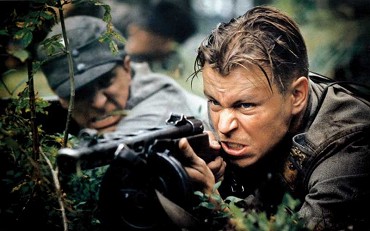
Rukajärven tie (Rukariver's road) is a post winter war-time movie directed by Olli Saarela. The movie first hit the cinema in January 1999.
The movie begins with a group of soldiers, that work under the main character lieutenant Eero Perkola, spending time on a beach in finland, waiting for orders for the next mission. However it is very hard to understand what exactly is going on in some of these moments as there is no build-up and possibility to understand who these characters are, as there are many. The other part of the story's drama aside from the main war part, is spent between the main character and her bride, Kaarina, sending letters and believing either of them dies every now and then. I think the beginning was meant for the watchers to get an understanding of these characters as stories usually have these "calm" times in the beginning to build-up to the serious stuff, and change the mood, but in this movie it fell flat on its face as the directing was terrible at times. I think the movie wasn't that bad but it felt low budget and try-hard. The writing was cookie cutter war-time stuff you'd find absolutely anywhere, no inspiration whatsoever. The story is just a linear yet somehow messy because of the terrible directing and dialogue which is hard to follow. The story is simple: a group of soldiers journey through their way to somewhere (who knows where, they just got some mission) and investigate every little building out there instead of looking back. That's it.
The climax of the movie happens in a forest where the main group takes on russians from behind and alot of explosions and shooting happens. I was *yawning* the whole way through though. As the deaths in this movie were predictable as hell, the characters acted in their archetypes (asshole idiot guy with the grenade and the one with the injured russian...) and when it did something unpredictable, it was god damn stupid. The movie after halfway through, well a bit before also, with the bride's situation after her group got killed by russians you know, was filled with deus ex machina moments that were also predictable (the main character obviously doesn't die, the bride, the young boys father dying, etc.). The ending made no sense (the bride, the MC and the injured guy who drowned??) and it felt cheesy. Out of the 20 or so characters I only remember 2 (because I looked them up) and wrote down 2 of those idiotic characters' names. None of them stood out in any shape or form .
The acting is kind of bad. The music is classical, which was expected and nothing special, and chuch-music like at one point, which surprised me I guess. It seemed rather low budget to me. I guess it was supposed to catch the realism of the war times but this movie was created in 1999. That's not an old movie by any means, they could have atleast tried making it better as the dialogue felt like it start-cut-start-cut, very obnoxious now that I think of it after watching. 4/10. I could care less how much of a historical value this has on some people. Terribly average plot with mostly everything else being bad. And I actually thought it had some potential half way through. I guess the movie aimed too high in presentation.
Rukajärven tie (Rukariver's road) is a post winter war-time movie directed by Olli Saarela. The movie first hit the cinema in January 1999.
The movie begins with a group of soldiers, that work under the main character lieutenant Eero Perkola, spending time on a beach in finland, waiting for orders for the next mission. However it is very hard to understand what exactly is going on in some of these moments as there is no build-up and possibility to understand who these characters are, as there are many. The other part of the story's drama aside from the main war part, is spent between the main character and her bride, Kaarina, sending letters and believing either of them dies every now and then. I think the beginning was meant for the watchers to get an understanding of these characters as stories usually have these "calm" times in the beginning to build-up to the serious stuff, and change the mood, but in this movie it fell flat on its face as the directing was terrible at times. I think the movie wasn't that bad but it felt low budget and try-hard. The writing was cookie cutter war-time stuff you'd find absolutely anywhere, no inspiration whatsoever. The story is just a linear yet somehow messy because of the terrible directing and dialogue which is hard to follow. The story is simple: a group of soldiers journey through their way to somewhere (who knows where, they just got some mission) and investigate every little building out there instead of looking back. That's it.
The climax of the movie happens in a forest where the main group takes on russians from behind and alot of explosions and shooting happens. I was *yawning* the whole way through though. As the deaths in this movie were predictable as hell, the characters acted in their archetypes (asshole idiot guy with the grenade and the one with the injured russian...) and when it did something unpredictable, it was god damn stupid. The movie after halfway through, well a bit before also, with the bride's situation after her group got killed by russians you know, was filled with deus ex machina moments that were also predictable (the main character obviously doesn't die, the bride, the young boys father dying, etc.). The ending made no sense (the bride, the MC and the injured guy who drowned??) and it felt cheesy. Out of the 20 or so characters I only remember 2 (because I looked them up) and wrote down 2 of those idiotic characters' names. None of them stood out in any shape or form .
The acting is kind of bad. The music is classical, which was expected and nothing special, and chuch-music like at one point, which surprised me I guess. It seemed rather low budget to me. I guess it was supposed to catch the realism of the war times but this movie was created in 1999. That's not an old movie by any means, they could have atleast tried making it better as the dialogue felt like it start-cut-start-cut, very obnoxious now that I think of it after watching. 4/10. I could care less how much of a historical value this has on some people. Terribly average plot with mostly everything else being bad. And I actually thought it had some potential half way through. I guess the movie aimed too high in presentation.
Subscribe to:
Posts (Atom)